5 Reasons Traditional Masking Fails and What Modern Clinics Should Use Instead

As audiologists and clinical directors, our professional mandate is to deliver transformative, evidence-based care. For decades, many clinics have relied on Tinnitus Sound Masking (TSM) as a primary acoustic intervention. While it offers temporary relief for some patients, TSM often falls short in achieving the ultimate goal: sustainable neural habituation and a reduction in tinnitus-related distress.
The current neurophysiological understanding of chronic tinnitus demands a paradigm shift, a pivot from symptom concealment to advanced, neuroplasticity-driven protocols. This shift is not just clinically ethical; it is essential for growing tinnitus revenue and establishing your clinic as a leader in advanced tinnitus management for audiologists.

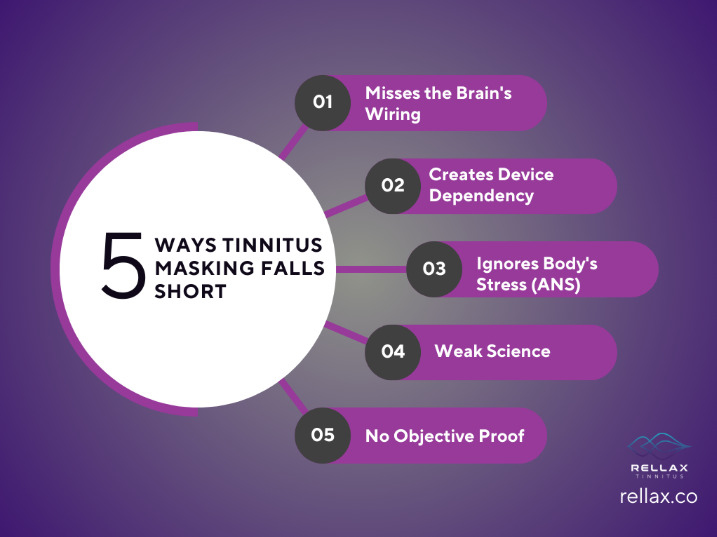
5 Reasons Why Sound Masking Doesn’t Work Long-Term
Traditional masking’s failure is rooted in its inability to interact constructively with the complex central neural networks driving chronic tinnitus distress.
1. It Treats the Noise, Not the Problem (Wrong Brain Changes)
Tinnitus is mainly caused by the brain getting “wired” the wrong way, we call this maladaptive neuroplasticity. The sound signal gets linked to the brain’s emotion center (the limbic system). Traditional masking only covers the sound symptom. It doesn’t fix this faulty wiring.
- Result: The underlying source of distress stays put. Treatments like Tinnitus Retraining Therapy (TRT) are proven to deliver much better, longer-lasting results, especially for patients who are highly distressed.
2. It Makes Patients Dependent (Prevents the Brain from Learning)
To get long-term relief, the patient’s brain must learn to ignore the tinnitus, this is called habituation. If the device completely covers the sound, the brain doesn’t have to work.
- Result: The patient gets stuck relying on the masker. Their brain never learns to filter the internal signal, so when the masker is off, the distress is immediately back.
3. It Ignores the Stress Response (The Body’s "Stress Button")
Severe tinnitus causes high stress and anxiety. This stress comes from the Autonomic Nervous System (ANS) being stuck in “fight-or-flight” mode (high sympathetic tone).
- Result: Masking is just a sound fix. It cannot teach the patient how to turn off their body’s deep stress response, which is what truly fuels the suffering.
4. It Lacks Strong Clinical Proof (Shouldn't Be Used Alone)
When tested in long-term studies, sound masking used by itself (monotherapy) isn’t nearly as strong as treatments that include teaching and counseling.
- Result: Major clinical guidelines now strongly recommend using psychological approaches like CBT (Cognitive Behavioral Therapy) because the counseling part is essential for lasting relief.
5. We Can’t Prove It’s Working (No Real Data)
Masking relies mostly on the patient telling you they feel better, usually through questionnaires. This subjective data is hard to justify to insurance companies or even the patient themselves.
- Result: We lack a measurable, scientific way to prove that the patient’s body is actually calming down and that the treatment is effective.
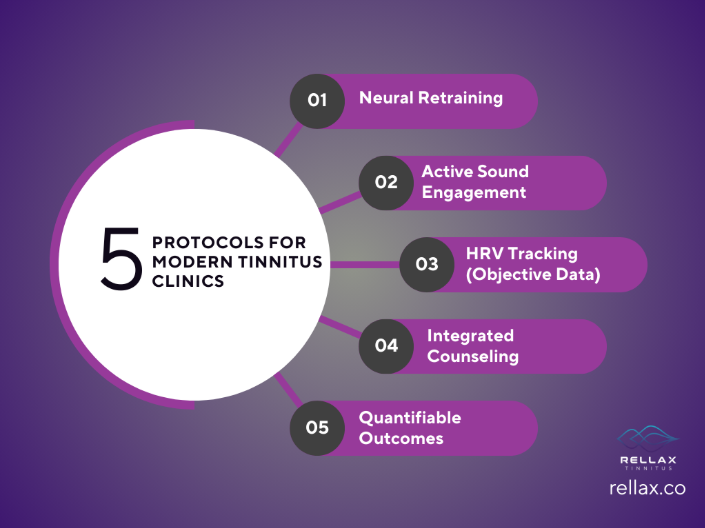
5 Essential Solutions for the Modern Tinnitus Clinic
The path to superior clinical outcomes lies in implementing an integrated, active management strategy centered on neuroplasticity and objective physiological assessment.
1. Teach the Brain to Ignore the Sound
Use focused teaching (directive counseling) to correct the patient’s wrong beliefs about their tinnitus. Guide them to understand that the sound is harmless. This switches the brain out of “threat mode” and allows neuroplasticity to work for them, not against them.
2. Use Sound to Help the Brain Learn
Instead of covering the tinnitus completely, use sound therapy at the “mixing point.” This is where the patient can still faintly hear the tinnitus along with the sound therapy. This method forces the brain to actively filter the internal noise, starting the process of true, long-term habituation.
3. Get Objective Data on Stress (HRV Tracking)
Bring in tools to track the Autonomic Nervous System, specifically Heart Rate Variability (HRV). HRV is a simple way to measure the body’s stress level.
- The Advantage: Low HRV equals high stress. As the patient improves, their HRV score goes up. This gives you and the patient clear, objective proof that the treatment is reducing their body’s stress response.
4. Offer Full, Integrated Care
Move away from single-solution sales. Offer structured, comprehensive programs that combine custom sound therapy with counseling. This aligns your clinic with the highest standards of evidence-based tinnitus care, solidifying your position as a trusted specialist.
5. Use Data to Justify Your Expertise
Use the HRV and other objective metrics to show the patient their real, measurable progress. This data validates your expertise and the value of your protocols. This shift moves your clinic from selling a basic device to offering a high-value medical service, significantly boosting tinnitus patient referrals.
Conclusion: The Imperative for Change
The limitations of traditional tinnitus masking are clear: they treat the noise, not the network. For chronic, bothersome tinnitus, reliance on masking is a disservice to the patient and an impediment to growing audiology practice revenue through high-value services.
Modern audiology clinics must embrace the neuroplasticity imperative by implementing comprehensive, habituation-based protocols supported by objective metrics like Heart Rate Variability (HRV). This shift is how your clinic achieves superior long-term tinnitus outcomes and solidifies its position as a forward-thinking provider of evidence-based tinnitus care.
Are you ready to move beyond the limitations of masking and embrace a more data-driven, neurophysiologically informed approach to tinnitus care?
Partner with Rellax to access our proprietary tools, evidence-based protocols, and comprehensive provider training. And with HRV-integrated insights coming soon, Rellax will further empower clinicians with deeper physiological data to support personalized tinnitus care.
Subscribe Now: https://rellax.co/providers/
Frequently Asked Questions (FAQs)
Masking only covers the sound, which is the symptom. It fails to address the underlying issue: the brain's emotional distress and faulty wiring, which is what causes the long-term suffering.
Heart Rate Variability (HRV) gives you objective proof that your advanced therapy is working by reducing the patient's physical stress response. This moves your service from being subjective (relying on patient self-reports) to being data-driven and high-value.
Patients often report feeling better quickly, but true, long-term brain change (habituation) usually takes 6 to 18 months of commitment.
Have any question?
Do not hesitate to contact us. We’re a team of experts ready to talk to you.