
How to Build a Tinnitus Treatment Plan Patients Actually Follow

A well-designed tinnitus treatment plan is not just about selecting the right therapy, it’s about ensuring patients actually follow it. While many clinics offer evidence-based solutions, adherence remains one of the biggest challenges in tinnitus care.
Most clinics do not have a treatment problem. They have a behavioral execution problem.
Therefore, the real challenge is not deciding what to prescribe, but designing a system patients can realistically follow outside the clinic.

Step 1: Educate Before You Prescribe
Most patients arrive wanting silence. When you cannot give that, they quit before starting.
The fix: Spend the entire first session on education. No devices. No prescriptions.
Your role is to reset expectations early:
- Tinnitus is aperception, not a disease
- The goal is reduced distress, not silence
- Habituation is the outcome
- Consistency over time drives results
Without this shift, even the best treatment plan will fail.
Step 2: Set a Specific Adherence Target
Vague instructions fail. “Use it when needed” leads to inconsistency.
Instead, define a clear structure.
The following evidence-based targets provide a simple, structured benchmark clinicians can use to guide patient behavior:
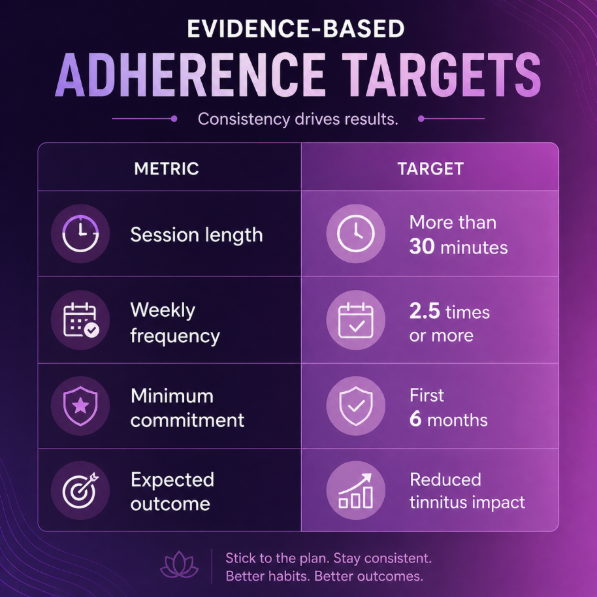
Patients who follow a consistent routine are more likely to build long-term habituation.
Action: Give patients a written target. Clarity improves follow-through
Step 3: Build a Weekly Session Schedule
A plan without a schedule is just intention.
Structure each week identically to build routine and reduce decision fatigue.
Sample weekly schedule:
Day | Activity | Duration |
Monday | Sound therapy (morning) + breathing (evening) | 45 min |
Tuesday | Sound therapy only | 60 min |
Wednesday | Sound therapy + muscle relaxation | 45 min |
Thursday | Rest day (low background sound only) | Passive |
Friday | Sound therapy + journaling | 60 min |
Saturday | Sound therapy + natural sounds | 45 min |
Sunday | Weekly check-in + goal setting | 10 min |
Repetition builds habits. However, including rest prevents burnout.
Step 4: Match the Plan to Their Primary Distress
Not all tinnitus patients struggle in the same way.
Use structured assessments such as THI or TFI to identify the dominant issue, then align the plan accordingly.
Primary Distress | First-Line Intervention | What to Avoid |
Sleep disturbance | Low-volume bedside sound therapy | High-volume masking |
Concentration problems | Low-level background sound during tasks | Silence during work |
Emotional distress | Counseling, CBT, or relaxation techniques | Avoidance behaviors |
Hearing loss plus tinnitus | Hearing aids with sound support | Sound-only without amplification |
Critical rule: Sound therapy should remain below tinnitus level to support habituation, not masking.
Step 5: Create a Structured Follow-Up System
The biggest drop in adherence happens after the initial motivation fades. Without structure, patients stop engaging with their plan.
The 3-7-21 follow-up rule:
Day | Action | Method | Time Needed |
3 | Check hardware setup and first session | Phone call | 3 minutes |
7 | Reinforce consistency and routine | Clinic-guided follow-up | 1 minute |
21 | Review usage and adjust plan if needed | In-clinic or remote review | 10 minutes |
Consistency is what drives outcomes.
Step 6: Use a Written Plan Template
Do not trust memory. Also, do not rely on verbal instructions.
Write every plan down. Then give the patient a copy. Finally, keep one in their chart.
A written template saves time and prevents mistakes. It also ensures every patient leaves with the same clear structure.
[Download the Tinnitus Treatment Plan Template (PDF)]
Use this template with every patient. Print it. Fill it out together. Watch adherence improve.
Takeaway
Ultimately, the success of a tinnitus treatment plan is not determined by the sophistication of therapies used, but by how seamlessly those therapies integrate into daily life.
The most effective clinicians are not those who prescribe the most interventions, but those who design structured behavioral systems patients can realistically follow over time.
Stop Guessing. Start Seeing Patient Progress
For audiology clinics, the biggest challenge in tinnitus care is not clinical expertise, it is patient adherence beyond the consultation room.
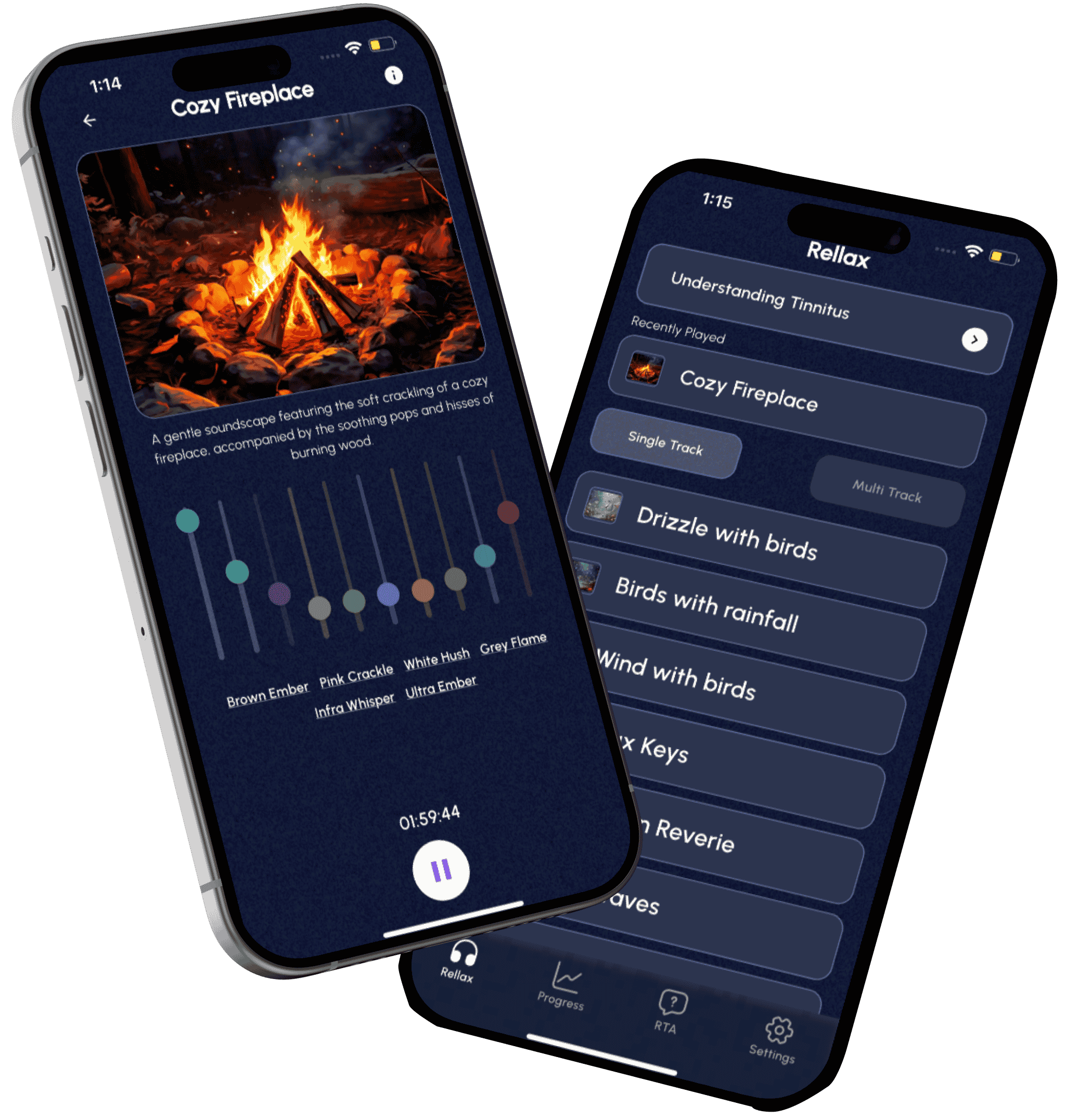
Rellax helps clinics extend tinnitus care into daily life through structured engagement systems, guided routines, and adherence-focused patient support.
Frequently Asked Questions (FAQs)
The most effective tinnitus treatment plan combines personalized sound therapy, a structured schedule, and consistent tracking of progress.
Most patients stop because the plan lacks structure or follow-up. Without consistency, even effective therapies fail.
Tinnitus management is a long-term process. With consistent therapy and tracking, patients gradually experience reduced distress and improved quality of life.
Have any question?
Do not hesitate to contact us. We’re a team of experts ready to talk to you.