
Tinnitus Brain Research: What New Studies Reveal About Adaptation

Tinnitus brain research is helping scientists understand an important question: why can tinnitus feel overwhelming when it first appears, yet become less intrusive for some people over time? New research suggests that the brain’s response to tinnitus may change as the condition moves from a recent experience to a chronic one.
A 2026 study published in iScience compared brain activity in people with recent-onset tinnitus, chronic tinnitus, and people without tinnitus. The findings offer a closer look at how different brain networks may respond to tinnitus over time.
What Did the Researchers Study?
The researchers studied 45 adults with clinically normal results on standard hearing tests:
- 15 people with recent-onset tinnitus lasting less than six months
- 15 people with chronic tinnitus
- 15 people without tinnitus
The researchers used a 64-channel EEG to record electrical brain activity. They then examined EEG microstates and dynamic functional connectivity.
In simple terms, these methods allowed researchers to observe brief patterns of brain activity and examine how different brain networks communicate and shift between states.
The researchers were particularly interested in whether these patterns differed between people with recent and chronic tinnitus.
What Did the Study Find?
The study found different patterns of brain activity between the recent-onset and chronic tinnitus groups.
Recent tinnitus may put the brain on high alert
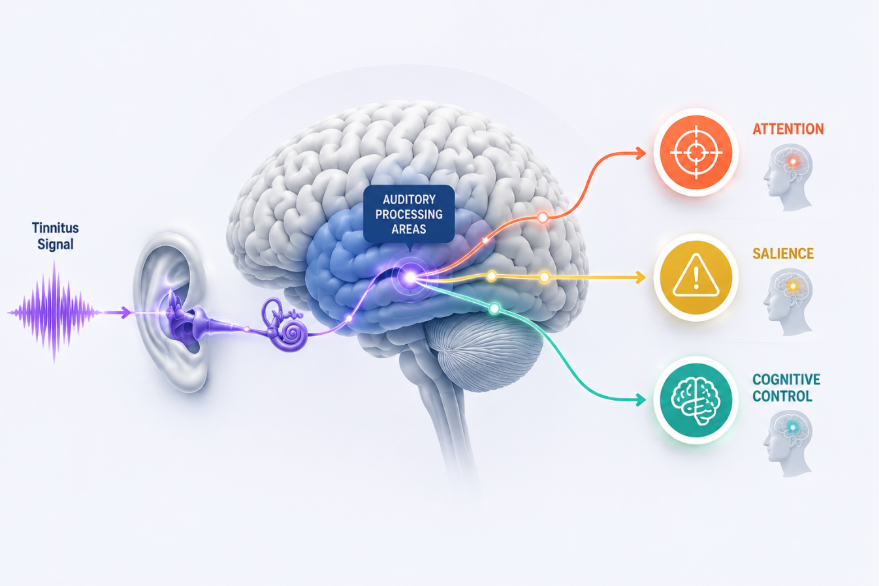
People with recent-onset tinnitus showed greater involvement of the salience network.
The salience network helps the brain identify information that seems important and deserves attention. At the same time, activity associated with the executive control network was reduced.
The executive control network is involved in managing attention and cognitive control.
Together, these findings may help explain why new tinnitus can feel so difficult to ignore. The brain may treat the unfamiliar sound as something important and repeatedly direct attention toward it.
This may contribute to hypervigilance, a state in which a person remains highly focused on the tinnitus and keeps checking whether it is still there.
Chronic Tinnitus Showed a Different Pattern
The chronic-tinnitus group showed a different pattern of brain-network activity.
Their networks appeared to switch in a more balanced way, with changes involving both auditory and executive-control systems.
Researchers interpreted this as a possible form of compensatory reorganization. In simple terms, the brain may gradually establish a different way of processing and responding to an ongoing tinnitus signal.
However, this does not mean the tinnitus itself disappears.
Instead, the research suggests that the brain’s response to the sound may change.
That distinction is important. Someone can continue to hear tinnitus while becoming less distracted or emotionally affected by it.
What Does This Tell Us About Tinnitus?
One of the most useful insights from this research is that hearing tinnitus and reacting strongly to tinnitus are not necessarily the same experience.
The sound can remain present while its perceived importance changes.
For example, a person may still notice tinnitus but find that it no longer dominates their attention in the same way. This helps explain the concept of tinnitus habituation, where tinnitus may become less intrusive or less emotionally disruptive over time.
The study does not prove that every person will experience this type of adaptation. However, it provides evidence that the brain’s relationship with tinnitus may not remain fixed.
Why Is This Research Important?
The findings show that tinnitus involves more than auditory processing alone. The researchers observed differences involving several brain systems connected with:
- Attention
- Salience
- Cognitive control
- Auditory processing
- Brain-network communication
This gives researchers a more detailed way to study how tinnitus may change across different stages.
The findings may eventually help researchers identify biological markers that distinguish recent-onset tinnitus from chronic tinnitus. However, more research is needed before EEG-based measures can become part of routine tinnitus care.
What Could This Mean for Tinnitus Care?
The study did not test a tinnitus treatment, so it cannot tell us whether a particular therapy causes the brain changes observed.
However, the findings reinforce the importance of looking at the patient’s overall experience, not only whether tinnitus is present, but also how much attention and emotional importance they give it.
For clinicians, this can provide a useful perspective when discussing progress with patients. Improvement does not necessarily have to mean eliminating the sound. It may also involve reducing how intrusive or disruptive it feels.
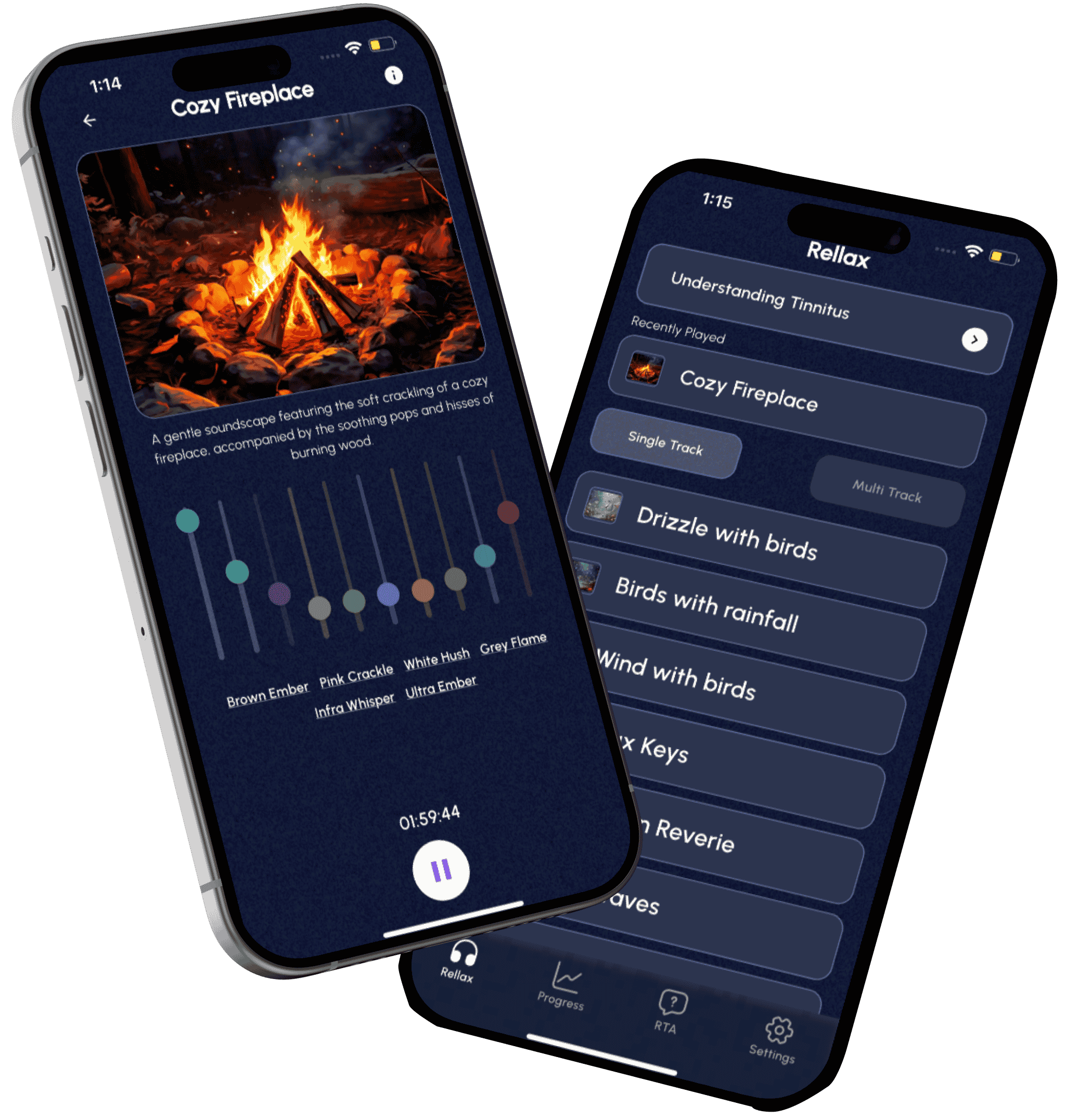
Rellax supports this ongoing approach with personalized sound therapy, progress tracking, and tools that help providers stay connected with patients between visits.
Takeaway
This study provides a new perspective on tinnitus and the brain.
Recent-onset tinnitus was associated with greater involvement of systems linked to attention and salience, while chronic tinnitus showed signs of more balanced brain-network activity.
The findings do not show that tinnitus simply disappears over time. Instead, they suggest that the brain may change how it processes and responds to the sound.
For patients and clinicians, that is an encouraging direction for future research: meaningful progress may involve not only the presence of tinnitus, but also how much attention, importance, and emotional impact the brain gives it.
Frequently Asked Questions (FAQs)
The study suggests that brain-network activity may change as tinnitus moves from recent-onset to chronic, although more research is needed.
Tinnitus habituation refers to becoming less aware of or less affected by tinnitus, even when the sound may still be present.
It is a brief pattern of electrical brain activity that researchers can use to study how brain networks organize and communicate.
Have any question?
Do not hesitate to contact us. We’re a team of experts ready to talk to you.